In a Review of More Than 7000 360-degree Performance Evaluations Women Were Rated Lower on
Operation direction is the process of communicating chore expectations to employees, engaging employees in goals-setting and coaching conversations, evaluating employee performance, and making talent management decisions related to compensation, placement, and development. One popular input to performance management and talent development is the utilize of multisource feedback (often called 360-caste feedback), where employees are rated on their performance by managers, peers, directly reports and fifty-fifty customers; and although this has several advantages, information technology carries its share of risks and pitfalls.
Many managers may be surprised to learn that men and women are evaluated differently for functioning reviews, and the cumulative bear upon of these differences tin affect the overall business performance.
Susan Colantuno, in her recent TED Talks, talked almost the three elements of leadership success that help propel careers i.east. personal greatness, engaging the greatness of others, and achieving & sustaining boggling outcomes. Career advice given to women emphasize on the ability to exist confident, creating a personal brand, negotiating, building communications skills, speaking up and engaging teams; yet, information technology misses out the third element of leadership success i.eastward. the business, strategic and fiscal apprehending required to be leaders.
Research suggests that women and men are assessed differently at work
- Women leaders are judged improve at caretaking leader behaviors and men at take charge behaviors.1
- Women are simply as likely to ask for feedback as their male colleagues but are less likely to go it.2
- Women get fewer, high visibility roles and experiences or hot jobs which cause gender gaps at senior levels.3
Women receive less helpful feedback than men
- Men received developmental feedback linked to business outcomes while women received feedback related to their personality rather than operation.4
- Women are less likely to receive constructive feedback and specific feedback tied to outcomes.v
- Women's receive more critical feedback and less constructive suggestions.6
- Women were 1.4 times more likely to receive disquisitional subjective feedback every bit opposed to either positive feedback or critical objective feedback.7
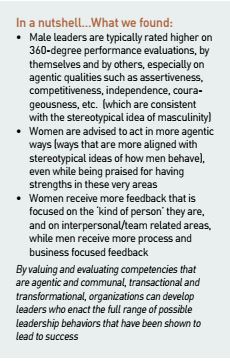
The differences in how male and female employees have evaluated matters because performance is evaluated against standards that are linked to the concern strategy. Even so, oftentimes, definitions of leadership and performance in organizations are gendered, and tend to be more masculine or consistent with male stereotypes.8
Women normally go caught between two unpalatable options: to act in stereotypically feminine means and risk non being taken seriously every bit a leader, or to act in more masculine means and being seen every bit non ladylike. This is the classic Double Bind dilemma12 and is also related to the Think Manager Call up Male phenomenon which establishes this greater overlap between masculine attributes and leadership attributes than between feminine attributes and leadership attributes.9
Paying attention to gendered functioning direction matters because notions of work and leadership are besides expanding. The agentic-versus-communali characteristic distinction applies here and parallels the transactional-transformational leadership styles distinction10 that has been well established by research. In fact, enquiry shows that transformational leadership behaviors have much greater affect on outcomes every bit varied as employee satisfaction and firm performance11, compared to transactional behaviors. Taking that argument further, if transformational (and communal) styles are beneficial, it stands to reason that leaders should be provided balanced feedback that replaces the prior focus on transactional (and agentic) behaviors.
Does India Inc. casualty victim to the same patterns?
In the face up of all this, nosotros set out to answer a few broad questions:
1. How do these patterns manifest similarly or differently in India?
2. If so, do these differences emerge in both numerical and narrative feedback?
three. What does this mean for the career growth of people from all genders?
In club to answer these questions, YSC India looked at the developmental feedback of mid to senior leaders in fifteen organizations in different industries in India. Overall, men tended to have more than raters and received more feedback than women, which highlights the gap in terms of exposure to feedback. Yet women received more than feedback in their development areas vs. strengths in comparison to their male counterparts. Women were also given more objective narrative feedback on their development areas with detail observations and examples in comparison to their strengths which were more subjective or vague.
Men rated themselves higher than women on competencies like Commercial Mindset, Strategic Focus, Developing High-Performance Team, Performance Mindset and Authentic Date which are more agentic in nature. Agentic qualities are associated more with masculine behaviors that convey assertion and command which are also synonymous with the traditional definition of constructive leadership. Not surprisingly, we saw that men were rated higher by others on competencies like Adaptive Thinking & Problem Solving and Strategic Focus which are arguably more agentic. There were fewer significant differences in competencies like Flexible Influencing Styles and Developing Others which are more communal qualities that include consensus building, collaborating and fostering growth.
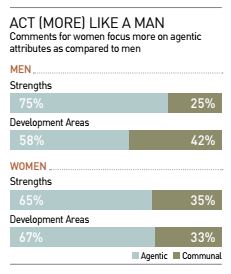
We saw that a majority (two/3rd) of the comments on strengths provided to women emphasized traits like cocky-advancement, independence, assertiveness, and decisiveness whereas only one/3rd emphasized traits similar developing others, collaboration, etc. This inverse across development areas where comments for women focused.
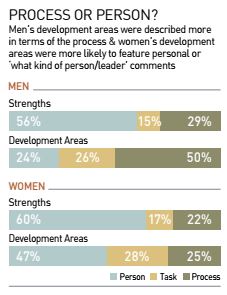
A like design emerged when we looked at the comments in terms of their Focus. Men's development areas were described more in terms of the process or 'how' they got piece of work washed compared to women'south (50% versus 29%). Women's development areas were more likely to feature personal or 'what kind of person/leader' comments (56% versus 24%).
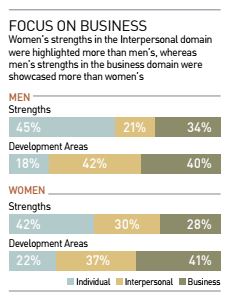
There were no significant differences across the iii areas. Nonetheless, women'south strengths in the Interpersonal domain were highlighted more than men'south (30% versus 21%). Men's strengths in the Business domain were showcased more than women's (34% versus 28%).
What can organizations and leaders do to ensure more counterbalanced and helpful feedback for all leaders?
The feedback given to women – a critical chemical element in their development journeys – is biased in predictably stereotypical ways and holds women back. Organizations and organizational leaders, regardless of gender can benefit from more than counterbalanced leadership, focused on borer into the full spectrum of leadership behaviors that is important for success.
What should organizations start doing?
- Track developmental feedback and opportunities past gender to identify potential gaps (in units, managers, functions).
- Train managers to ensure that feedback given to all employees is balanced i.e. focused on both, the relationship and business/task aspects of work.
- Ensure that men are receiving enough feedback on the communal and transformational aspects of leadership and not just the agentic.
- Review the language used in performance direction including competency models to avoid gendered linguistic communication
What should organizations stop doing?
- Think Manager, Think Male: Define leadership, competence and functioning in gendered (masculine) terms
- Assume that the annual performance reviews will automatically outcome in employee development
- Focusing performance appraisal training only on the mechanics (east.g. rating scales) but ignoring the importance of a feedback culture
What should organizations continue doing?
- Use multisource (360 degree) reviews as a powerful feedback/employee development tool, distinct from performance appraisal that results in pay/promotion decisions.
- Integrate feedback and coaching into larger strategic 60 minutes and talent management initiatives, and ensure access to women and men in proportional terms.
What can you exercise?
- Create objective criteria and provide support or exposure needed for optimal performance.
- Examine carefully the words you lot use in your performance feedback – Are they gender neutral?
- Check if your feedback is helpful and specific – substantiate it with examples?
- Detect the employee and value the person's behavior in different contexts.
- Constantly bank check whether your feedback is affected by gender role expectations – Ask yourself if you would say this to someone of the opposite gender if they behaved this way?
- Agentic qualities are those that emphasize cocky-advancement, independence, assertiveness, control and decisiveness (such as adamant, dominant, competitive). In dissimilarity, communal attributes are nurturing traits that emphasize maintenance of social relationships, social activities similar consensus building, developing others and collaboration (such as warm, helpful, cooperative).
- Insights from narrative feedback indicates trends and patterns merely not statistically pregnant differences.
References
1 Catalyst, Inc. (2005). Women "Have Care," Men "Take Accuse
2 Lean In & McKinsey (2016). Women in the Workplace
3 Goad Inc. (2012). Proficient Intentions, Imperfect Execution? Women Become Fewer Of The "Hot Jobs" Needed To Accelerate
four Silverman, R. E. (2015). Gender Bias at Work Turns Upward in Feedback. Wall Street Periodical, i–5.
five Correll, Due south., & Simard, C. (2016). Research: Vague Feedback Is Holding Women Back. Harvard Business Review
6 Snyder, 1000. (2014). The abrasiveness trap: Loftier-achieving men and women are described differently in reviews. Fortune
seven Cecchi-Dimeglio, P. (2017). How Gender Bias Corrupts Performance Reviews, and What to Do About It. Harvard Concern Review.
8 Koenig, A. M., Eagly, A. H., Mitchell, A. A., & Ristikari, T. (2011). Are leader stereotypes masculine? A meta-analysis of iii research paradigms. Psychological Message, 137(4), 616-642.
9 Schein, V. E., & Davidson, One thousand. J. (1993). Think manager, remember male. Management Evolution Review, six(3), 24.
11 Dumdum, U. R., Lowe, 1000. B., & Avolio, B. J. (2013). A meta-analysis of transformational and transactional leadership correlates of effectiveness and satisfaction: An update and extension. In Transformational and Charismatic Leadership: The Route Alee tenth Anniversary Edition (pp. 39-lxx). Emerald Grouping Publishing Express.
12 Catalyst, Inc. (2007). The double-bind dilemma for women in leadership: Damned if you exercise, doomed if you don't.
Source: https://www.peoplematters.in/article/culture/360-degrees-of-grey-the-impact-of-gendered-feedback-16817
0 Response to "In a Review of More Than 7000 360-degree Performance Evaluations Women Were Rated Lower on"
Post a Comment