Explain How Buck Once Again Predicted Calamity. Call of the Wild
 Starting time edition cover | |
| Author | Jack London |
|---|---|
| Illustrator | Philip R. Goodwin and Charles Livingston Bull |
| Encompass artist | Charles Edward Hooper |
| Country | The states |
| Language | English |
| Genre | Run a risk fiction |
| Prepare in | Santa Clara Valley and the Yukon, c. 1896–99 |
| Publisher | Macmillan |
| Publication date | 1903 |
| Media type | Print (Serial, Hardcover & Paperback) |
| Pages | 232 (Beginning edition) |
| OCLC | 28228581 |
| Dewey Decimal | 813.iv |
| LC Class | PS3523 .O46 |
| Followed past | White Fang |
| Text | The Call of the Wild at Wikisource |
The Phone call of the Wild is a short adventure novel past Jack London, published in 1903 and gear up in Yukon, Canada, during the 1890s Klondike Gold Rush, when strong sled dogs were in high demand. The key grapheme of the novel is a dog named Cadet. The story opens at a ranch in Santa Clara Valley, California, when Buck is stolen from his abode and sold into service as a sled dog in Alaska. He becomes progressively more archaic and wild in the harsh environment, where he is forced to fight to survive and dominate other dogs. By the finish, he sheds the veneer of civilization, and relies on primordial instinct and learned feel to emerge as a leader in the wild.
London spent almost a year in the Yukon, and his observations class much of the material for the book. The story was serialized in The Saturday Evening Post in the summertime of 1903 and was published later that year in volume grade. The book'southward bang-up popularity and success made a reputation for London. Equally early on as 1923, the story was adapted to motion picture, and information technology has since seen several more cinematic adaptations.
Plot summary [edit]
The story opens in 1897 with Buck, a powerful 140-pound St. Bernard–Scotch Collie mix,[1] [two] happily living in California's Santa Clara Valley equally the pampered pet of Judge Miller and his family unit. One dark, assistant gardener Manuel, needing coin to pay off gambling debts, steals Buck and sells him to a stranger. Buck is shipped to Seattle where he is confined in a crate, starved, and ill-treated. When released, Buck attacks his handler, the "man in the ruddy sweater", who teaches Buck the "police force of club and fang", sufficiently cowing him. The man shows some kindness after Buck demonstrates obedience.
Before long after, Buck is sold to two French-Canadian dispatchers from the Canadian government, François and Perrault, who take him to Alaska. Buck is trained as a sled dog for the Klondike region of Canada. In add-on to Buck, François and Perrault add an additional 10 dogs to their team (Spitz, Dave, Dolly, Expressway, Dub, Billie, Joe, Sol-leks, Teek, and Koona). Buck's teammates teach him how to survive cold wintertime nights and nearly pack gild. Over the next several weeks on the trail, a bitter rivalry develops between Buck and the atomic number 82 dog, Spitz, a vicious and quarrelsome white husky. Buck eventually kills Spitz in a fight and becomes the new pb dog.
When François and Perrault consummate the round-trip of the Yukon Trail in record time, returning to Skagway with their dispatches, they are given new orders from the Canadian government. They sell their sled squad to a "Scotch half-breed" man, who works in the postal service. The dogs must make long, tiring trips, carrying heavy loads to the mining areas. While running the trail, Buck seems to have memories of a canine ancestor who has a brusk-legged "hairy man" companion. Meanwhile, the weary animals become weak from the difficult labor, and the wheel dog, Dave, a morose husky, becomes terminally sick and is eventually shot.
With the dogs too wearied and footsore to be of utilise, the mail-carrier sells them to three stampeders from the American Southland (the nowadays-twenty-four hours contiguous United states)—a vain adult female named Mercedes, her sheepish married man Charles, and her big-headed brother Hal. They lack survival skills for the Northern wilderness, struggle to control the sled, and ignore others' helpful advice—particularly warnings about the dangerous leap cook. When told her sled is as well heavy, Mercedes dumps out crucial supplies in favor of manner objects. She and Hal foolishly create a squad of fourteen dogs, believing they will travel faster. The dogs are overfed and overworked, then are starved when food runs low. Most of the dogs die on the trail, leaving but Buck and four other dogs when they pull into the White River.
The group meets John Thornton, an experienced outdoorsman, who notices the dogs' poor, weakened status. The trio ignores Thornton's warnings near crossing the ice and press onward. Exhausted, starving, and sensing danger ahead, Buck refuses to proceed. Afterwards Hal whips Cadet mercilessly, a disgusted and angry Thornton hits him and cuts Cadet free. The group presses onward with the four remaining dogs, but their weight causes the ice to break and the dogs and humans (along with their sled) to fall into the river and drown.
As Thornton nurses Buck back to health, Buck grows to love him. Buck kills a malicious homo named Burton by vehement out his throat because Burton hitting Thornton while the latter was defending an innocent "tenderfoot." This gives Cadet a reputation all over the N. Cadet also saves Thornton when he falls into a river. After Thornton takes him on trips to pan for gold, a bonanza king (someone who struck information technology rich in the gold fields) named Mr. Matthewson wagers Thornton on Buck's force and devotion. Buck pulls a sled with a half-ton (ane,000-pound (450 kg)) load of flour, breaking it costless from the frozen ground, dragging information technology 100 yards (91 m) and winning Thornton US$1,600 in gold dust. A "rex of the Skookum Benches" offers a large sum (Usa$700 at first, then $1,200) to purchase Buck, but Thornton declines and tells him to go to hell.
Using his winnings, Thornton pays his debts just elects to continue searching for gold with partners Pete and Hans, sledding Buck and six other dogs to search for a fabled Lost Cabin. Once they locate a suitable gold find, the dogs notice they have nothing to do. Cadet has more ancestor-memories of existence with the archaic "hairy man."[iii] While Thornton and his 2 friends pan gold, Buck hears the call of the wild, explores the wilderness, and socializes with a northwestern wolf from a local pack. Nonetheless, Buck does not bring together the wolves and returns to Thornton. Buck repeatedly goes back and along betwixt Thornton and the wild, unsure of where he belongs. Returning to the campsite one twenty-four hour period, he finds Hans, Pete, and Thornton forth with their dogs have been murdered by Native American Yeehats. Enraged, Buck kills several Natives to avenge Thornton, and then realizes he no longer has any human ties left. He goes looking for his wild brother and encounters a hostile wolf pack. He fights them and wins, then discovers that the solitary wolf he had socialized with is a pack fellow member. Buck follows the pack into the woods and answers the telephone call of the wild.
The legend of Buck spreads among other Native Americans equally the "Ghost Dog" of the Northland (Alaska and northwestern Canada). Each yr, on the ceremony of his attack on the Yeehats, Buck returns to the former campsite where he was last with Thornton, Hans, and Pete, to mourn their deaths. Every wintertime, leading the wolf pack, Buck wreaks vengeance on the Yeehats "as he sings a song of the younger earth, which is the vocal of the pack."
Main characters [edit]
Major canis familiaris characters:
- Buck, the novel's protagonist; a 140-pound St. Bernard–Scotch Collie mix who lived contentedly in California with Guess Miller. However, he was stolen and sold to the Klondike by the gardener'southward assistant Manuel and was forced to work as a sled dog in the harsh Yukon. He eventually finds a loving master named John Thornton and gradually grows feral every bit he adapts to the wilderness, somewhen joining a wolf pack. After Thornton's expiry, he is free of humans forever and becomes a legend in the Klondike.
- Spitz, the novel'due south initial adversary and Cadet's curvation-rival; a white-haired croaking from Spitsbergen who had accompanied a geological survey into the Canadian Barrens. He has a long career equally a sled dog leader, and sees Buck'due south uncharacteristic ability, for a Southland canis familiaris, to suit and thrive in the North as a threat to his dominance. He repeatedly provokes fights with Cadet, who bides his time.
- Dave, the 'wheel dog' at the back cease of the dog-team. He is brought Due north with Buck and Spitz and is a faithful sled domestic dog who simply wants to be left alone and led by an effective lead domestic dog. During his second downwardly-expedition on the Yukon Trail, he grows mortally weak, just the men accommodate his pride by allowing him to go on to drive the sled until he becomes and then weak that he is euthanized.
- Curly, a large Newfoundland dog who was murdered and eaten by native huskies.
- Billee, a skillful-natured, appeasing husky who faithfully pulls the sled until being worked to death by Hal, Charles, and Mercedes.
- Dolly, a potent husky purchased in Dyea, Alaska by Francois and Perrault. Dolly is desperately injure after an assault of wild dogs, and she afterwards goes rabid herself, furiously attacking the other sled dogs including Buck, until her skull is smashed in by Francois every bit he struggles to end her madness.
- Joe, Billee'due south brother, but with an opposite personality— sour and introspective. Spitz is unable to bailiwick him, but Cadet, after rising to the head of the team, brings him into line.
- Sol-leks ('The Angry I'), a ane-eyed husky who does not like beingness approached from his blind side. Like Dave, he expects naught, gives naught, and only cares nearly being left alone and having an effective lead domestic dog.
- Pike, a clever malingerer and thief
- Dub, an awkward blunderer, always getting defenseless
- Teek and Koona, additional huskies on the Yukon Trail dog-team
- Skeet and Nig, 2 Southland dogs owned past John Thornton when he acquires Buck
- The Wild Brother, a lone wolf who befriends Buck
Major homo characters:
- Estimate Miller, Buck's outset master who lived in Santa Clara Valley, California with his family. Different Thornton, he but expressed friendship with Cadet, whereas Thornton expressed dearest.
- Manuel, Approximate Miller'southward employee who sells Buck to the Klondike to pay off his gambling debts.
- The Man in the Red Sweater, a trainer who beats Buck to teach him the law of the lodge.
- Perrault, a French-Canadian courier for the Canadian regime who is Cadet's first Northland primary.
- François, a French-Canadian mixed race man and Perrault'due south partner, the musher who drives the sled dogs.
- Hal, an aggressive and violent musher who is Mercedes' brother and Charles' brother-in-constabulary; he is inexperienced with handling sled dogs.
- Charles, Mercedes' married man, who is less violent than Hal.
- Mercedes, a spoiled and pampered woman who is Hal'southward sister and Charles' married woman.
- John Thornton, a gold hunter who is Buck's last chief until he is killed by the Yeehats.
- Pete and Hans —John Thornton'southward two partners as he pans for gold in the East.
- The Yeehats, a tribe of Native Americans. Afterward they impale John Thornton, Buck attacks them, and eternally 'dogs' them after going wild—assuring they never re-enter the valley where his final master was murdered.
Background [edit]

California native Jack London had traveled around the Us as a hobo, returned to California to cease high school (he dropped out at historic period 14), and spent a year in college at Berkeley, when in 1897 he went to the Klondike by way of Alaska during the summit of the Klondike Gold Rush. Later, he said of the experience: "It was in the Klondike I establish myself."[4]
He left California in July and traveled by boat to Dyea, Alaska, where he landed and went inland. To reach the aureate fields, he and his party transported their gear over the Chilkoot Pass, often carrying loads equally heavy as 100 pounds (45 kg) on their backs. They were successful in staking claims to eight gold mines along the Stewart River.[5]
London stayed in the Klondike for almost a year, living temporarily in the frontier town of Dawson Metropolis, earlier moving to a nearby winter camp, where he spent the winter in a temporary shelter reading books he had brought: Charles Darwin's On the Origin of Species and John Milton's Paradise Lost.[half dozen] In the wintertime of 1898, Dawson City was a urban center comprising about thirty,000 miners, a saloon, an opera house, and a street of brothels.[7]

Klondike routes map. The section connecting Dyea/Skagway with Dawson is referred to by London as the "Yukon Trail".
In the leap, as the annual gold stampeders began to stream in, London left. He had contracted scurvy, common in the Arctic winters where fresh produce was unavailable. When his gums began to groovy he decided to return to California. With his companions, he rafted 2,000 miles (3,200 km) downward the Yukon River, through portions of the wildest territory in the region, until they reached St. Michael. There, he hired himself out on a gunkhole to earn return passage to San Francisco.[eight]
In Alaska, London constitute the material that inspired him to write The Call of the Wild.[4] Dyea Beach was the main bespeak of arrival for miners when London traveled through in that location, but because its access was treacherous Skagway presently became the new arrival point for prospectors.[ix] To reach the Klondike, miners had to navigate White Pass, known every bit "Expressionless Horse Laissez passer", where horse carcasses littered the route because they could non survive the harsh and steep ascent. Horses were replaced with dogs as pack animals to ship material over the laissez passer;[10] particularly stiff dogs with thick fur were "much desired, scarce and loftier in price".[11]
London would have seen many dogs, particularly prized husky sled dogs, in Dawson City and in the winter camps situated shut to the principal sled route. He was friends with Marshall Latham Bail and his blood brother Louis Whitford Bail, the owners of a mixed St. Bernard-Scotch Collie dog about which London later wrote: "Yep, Buck is based on your canis familiaris at Dawson."[12] Beinecke Library at Yale Academy holds a photo of Bail's dog, taken during London's stay in the Klondike in 1897. The depiction of the California ranch at the beginning of the story was based on the Bail family ranch.[13]
Publication history [edit]
On his return to California, London was unable to find piece of work and relied on odd jobs such every bit cut grass. He submitted a query letter to the San Francisco Message proposing a story almost his Alaskan take a chance, just the idea was rejected considering, every bit the editor told him, "Interest in Alaska has subsided in an astonishing degree."[8] A few years later on, London wrote a curt story about a domestic dog named Bâtard who, at the end of the story, kills his primary. London sold the piece to Cosmopolitan Magazine, which published it in the June 1902 issue under the title "Diablo – A Dog".[14] London'due south biographer, Earle Labor, says that London and so began piece of work on The Call of the Wild to "redeem the species" from his dark characterization of dogs in "Bâtard". Expecting to write a brusque story, London explains: "I meant information technology to exist a companion to my other dog story 'Bâtard' ... but information technology got away from me, and instead of 4,000 words it ran 32,000 earlier I could phone call a halt."[xv]
Written equally a frontier story about the gold blitz, The Call of the Wild was meant for the pulp market. It was first published in four installments in The Saturday Evening Post, which bought it for $750 in 1903.[16] [17] In the same year, London sold all rights to the story to Macmillan, which published it in book format.[17] The book has never been out of print since that fourth dimension.[17]
Editions [edit]
- The first edition, past Macmillan, released in August 1903, had x tipped-in color plates by illustrators Philip R. Goodwin and Charles Livingston Bull, and a colour frontispiece by Charles Edward Hooper; information technology sold for $one.50.[18] [19] Information technology is presently available with the original illustrations at the Internet Archive.[20]
Genre [edit]

Buck proves himself as leader of the pack when he fights Spitz "to the death".
The Call of the Wild falls into the categories of adventure fiction and what is sometimes referred to equally the animal story genre, in which an author attempts to write an animal protagonist without resorting to anthropomorphism. At the time, London was criticized for attributing "unnatural" human thoughts and insights to a dog, so much and then that he was accused of being a nature faker.[21] London himself dismissed these criticisms as "homocentric" and "amateur".[22] London further responded that he had set out to portray nature more accurately than his predecessors.
"I have been guilty of writing two creature stories—two books about dogs. The writing of these two stories, on my part, was in truth a protestation against the 'humanizing' of animals, of which information technology seemed to me several 'animal writers' had been greatly guilty. Time and again, and many times, in my narratives, I wrote, speaking of my domestic dog-heroes: 'He did not recall these things; he but did them,' etc. And I did this repeatedly, to the clogging of my narrative and in violation of my creative canons; and I did it in order to hammer into the average human understanding that these canis familiaris-heroes of mine were not directed by abstruse reasoning, merely by instinct, awareness, and emotion, and by simple reasoning. Also, I endeavored to make my stories in line with the facts of evolution; I hewed them to the mark set past scientific research, and awoke, 1 day, to observe myself bundled neck and crop into the camp of the nature-fakers."[23]
Along with his contemporaries Frank Norris and Theodore Dreiser, London was influenced by the naturalism of European writers such equally Émile Zola, in which themes such equally heredity versus environment were explored. London's employ of the genre gave information technology a new vibrancy, according to scholar Richard Lehan.[24]
The story is also an example of American pastoralism—a prevailing theme in American literature—in which the mythic hero returns to nature. As with other characters of American literature, such as Rip van Winkle and Huckleberry Finn, Cadet symbolizes a reaction against industrialization and social convention with a return to nature. London presents the motif only, clearly, and powerfully in the story, a motif later on echoed by 20th century American writers William Faulkner and Ernest Hemingway (most notably in "Big Ii-Hearted River").[25] E.Fifty. Doctorow says of the story that it is "fervently American".[26]
The enduring appeal of the story, according to American literature scholar Donald Pizer, is that information technology is a combination of allegory, parable, and legend. The story incorporates elements of age-old beast fables, such equally Aesop's Fables, in which animals speak truth, and traditional brute fables, in which the beast "substitutes wit for insight".[27] London was influenced by Rudyard Kipling's The Jungle Volume, written a few years before, with its combination of parable and brute legend,[28] and past other beast stories pop in the early 20th century. In The Phone call of the Wild, London intensifies and adds layers of meaning that are lacking in these stories.[xv]
As a writer, London tended to skimp on form, according to biographer Labor, and neither The Call of the Wild nor White Fang "is a conventional novel".[29] The story follows the archetypal "myth of the hero"; Buck, who is the hero, takes a journeying, is transformed, and achieves an apotheosis. The format of the story is divided into four distinct parts, according to Labor. In the first part, Cadet experiences violence and struggles for survival; in the second part, he proves himself a leader of the pack; the third part brings him to his death (symbolically and well-nigh literally); and in the fourth and final part, he undergoes rebirth.[xxx]
Themes [edit]
London's story is a tale of survival and a return to primitivism. Pizer writes that: "the strong, the shrewd, and the cunning shall prevail when ...life is bestial".[31]
Pizer as well finds evident in the story a Christian theme of love and redemption, equally shown by Buck's refusal to revert to violence until later the expiry of Thornton, who had won Buck'due south love and loyalty.[32] London, who went then far as to fight for custody of one of his own dogs, understood that loyalty betwixt dogs (particularly working dogs) and their masters is built on trust and love.[33]
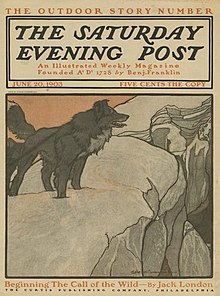
The Call of the Wild (cover of the June twenty, 1903 Sat Evening Mail shown) is about the survival of the fittest.[26]
Writing in the "Introduction" to the Modernistic Library edition of The Call of the Wild, E. L. Doctorow says the theme is based on Darwin's concept of survival of the fittest. London places Buck in disharmonize with humans, in conflict with the other dogs, and in conflict with his environs—all of which he must challenge, survive, and conquer.[26] Buck, a domesticated dog, must call on his atavistic hereditary traits to survive; he must learn to be wild to become wild, according to Tina Gianquitto. He learns that in a world where "the club and the fang" are law, where the law of the pack rules and a good-natured dog such equally Curly can be torn to pieces by pack members, that survival by whatever ways is paramount.[34]
London also explores the idea of "nature vs. nurture". Buck, raised as a pet, is by heredity a wolf. The change of surroundings brings up his innate characteristics and strengths to the betoken where he fights for survival and becomes leader of the pack. Pizer describes how the story reflects human nature in its prevailing theme of the strength, particularly in the face of harsh circumstances.[32]
The veneer of civilization is thin and frail, writes Doctorow, and London exposes the brutality at the core of humanity and the ease with which humans revert to a state of primitivism.[26] His interest in Marxism is evident in the sub-theme that humanity is motivated by materialism; and his interest in Nietzschean philosophy is shown by Buck's characterization.[26] Gianquitto writes that in Buck'due south characterization, London created a type of Nietschean Übermensch – in this example a domestic dog that reaches mythic proportions.[35]
Doctorow sees the story as a caricature of a bildungsroman – in which a graphic symbol learns and grows – in that Buck becomes progressively less civilized.[26] Gianquitto explains that Cadet has evolved to the point that he is prepare to join a wolf pack, which has a social construction uniquely adapted to and successful in the harsh Arctic environs, unlike humans, who are weak in the harsh surround.[36]
Writing style [edit]
The first chapter opens with the first quatrain of John Myers O'Hara'due south poem, Atavism,[37] published in 1902 in The Bookman. The stanza outlines one of the main motifs of The Call of the Wild: that Cadet when removed from the "sun-kissed" Santa Clara Valley where he was raised, will revert to his wolf heritage with its innate instincts and characteristics.[38]
The themes are conveyed through London's use of symbolism and imagery which, according to Labor, vary in the different phases of the story. The imagery and symbolism in the offset stage, to practise with the journey and self-discovery, depict physical violence, with strong images of pain and blood. In the second stage, fatigue becomes a dominant epitome and death is a ascendant symbol, equally Cadet comes close to beingness killed. The tertiary phase is a period of renewal and rebirth and takes place in the spring, before ending with the fourth phase, when Cadet fully reverts to nature is placed in a vast and "weird temper", a place of pure emptiness.[39]
The setting is allegorical. The southern lands represent the soft, materialistic world; the northern lands symbolize a world beyond civilization and are inherently competitive.[32] The harshness, brutality, and emptiness in Alaska reduce life to its essence, as London learned, and information technology shows in Buck's story. Buck must defeat Spitz, the dog who symbolically tries to go ahead and take command. When Buck is sold to Charles, Hal, and Mercedes, he finds himself in a camp that is dingy. They treat their dogs badly; they are artificial interlopers in the pristine landscape. Conversely, Buck's side by side masters, John Thornton and his two companions, are described as "living shut to the world". They keep a clean camp, care for their animals well, and stand for man's nobility in nature.[25] Unlike Cadet, Thornton loses his fight with his boyfriend species, and not until Thornton's death does Buck revert fully to the wild and his primordial state.[40]
The characters too are symbolic of types. Charles, Hal, and Mercedes symbolize vanity and ignorance, while Thornton and his companions represent loyalty, purity, and dearest.[32] Much of the imagery is stark and simple, with an accent on images of cold, snow, water ice, darkness, meat, and blood.[forty]
London varied his prose fashion to reflect the activeness. He wrote in an over-affected style in his descriptions of Charles, Hal, and Mercedes' camp as a reflection of their intrusion in the wilderness. Conversely, when describing Buck and his actions, London wrote in a way that was pared downwards and simple—a style that would influence and be the forebear of Hemingway's manner.[25]
The story was written as a frontier adventure and in such a way that it worked well equally a series. Every bit Doctorow points out, it is skilful episodic writing that embodies the fashion of magazine adventure writing pop in that menses. "It leaves us with satisfaction at its outcome, a story well and truly told," he said.[26]
Reception and legacy [edit]

The Call of the Wild was enormously popular from the moment information technology was published. H. L. Mencken wrote of London's story: "No other popular writer of his time did whatsoever ameliorate writing than you will observe in The Call of the Wild."[iv] A reviewer for The New York Times wrote of it in 1903: "If aught else makes Mr. London'southward book pop, it ought to be rendered so by the complete way in which it volition satisfy the dear of dog fights apparently inherent in every man."[41] The reviewer for The Atlantic Monthly wrote that it was a volume: "untouched by bookishness...The making and the achievement of such a hero [Buck] constitute, not a pretty story at all, but a very powerful one."[42]
The book secured London a place in the canon of American literature.[35] The outset printing of 10,000 copies sold out immediately; it is still one of the best known stories written by an American author, and continues to be read and taught in schools.[26] [43] It has been published in 47 languages.[44] London's kickoff success, the volume secured his prospects every bit a writer and gained him a readership that stayed with him throughout his career.[26] [35]
After the success of The Call of the Wild, London wrote to Macmillan in 1904 proposing a 2d volume (White Fang) in which he wanted to describe the opposite of Buck: a canis familiaris that transforms from wild to tame: "I'm going to reverse the process...Instead of devolution of decivilization ... I'm going to give the development, the civilization of a canis familiaris."[45]
Adaptations [edit]
The first accommodation of London's story was a silent pic made in 1923.[46] The 1935 version starring Clark Gable and Loretta Immature expanded John Thornton's role and was the first "talkie" to feature the story. The 1972 film The Phone call of the Wild, starring Charlton Heston as John Thornton, was filmed in Finland.[47] The 1978 Snoopy TV special What a Nightmare, Charlie Brown! is another adaptation. In 1981, an anime film titled Call of the Wild: Howl Cadet was released, starring Mike Reynolds and Bryan Cranston. A 1997 adaptation called The Call of the Wild: Canis familiaris of the Yukon starred Rutger Hauer and was narrated past Richard Dreyfuss. The Hollywood Reporter said that Graham Ludlow's adaptation was, "... a pleasant surprise. Much more true-blue to Jack London'southward 1903 classic than the two Hollywood versions."[48]
In 1983-1984 Hungarian comics artist Imre Sebök made a comic book adaptation of Call of the Wild, which was as well translated in German. [49] A comic accommodation had been made in 1998 for Boys' Life magazine. Out of cultural sensitivities, the Yeehat Native Americans are omitted, and John Thornton'due south killers are at present white criminals who, equally before, are also killed by Cadet.
A telly adaptation was released in 2000 on Creature Planet. Information technology ran for a unmarried season of 13 episodes, and was released on DVD in 2010 every bit a feature pic.
Chris Sanders directed another film adaptation titled The Call of the Wild, a live-action/estimator-blithe film, released on Feb 21, 2020, by 20th Century Studios. Harrison Ford stars as the lead function and Terry Notary provides the motion-capture performance[50] for Buck the domestic dog, with the canine graphic symbol then brought to life by MPC'southward animators.
References [edit]
- ^ London 1998, p. 4.
- ^ London 1903, Affiliate 1.
- ^ London 1903, Chapter vii.
- ^ a b c "Jack London" 1998, p. vi.
- ^ Courbier-Tavenier, p. 240.
- ^ Courbier-Tavenier, p. 240–241.
- ^ Dyer, p. 60.
- ^ a b Labor & Reesman, pp. 16–17.
- ^ Giantquitto, 'Endnotes', pp. 294–295.
- ^ Dyer, p. 59.
- ^ "Comments and Questions", p. 301.
- ^ Courbier-Tavenier, p. 242.
- ^ Doon.
- ^ Labor & Reesman, pp. 39–xl.
- ^ a b Labor & Reesman, p. forty.
- ^ Doctorow, p. xi.
- ^ a b c Dyer, p. 61.
- ^ Smith, p. 409.
- ^ Leypoldt, p. 201.
- ^ London, Jack (1903). The Call of the Wild. Illustrated past Philip R. Goodwin and Charles Livingston Balderdash (First ed.). MacMillan.
- ^ Pizer, pp. 108–109.
- ^ "London Answers Roosevelt; Revives the Nature Faker Dispute – Calls President an Amateur"
- ^ Revolution and Other Essays: The Other Animals". The Jack London Online Collection. Retrieved April 15, 2010.
- ^ Lehan, p. 47.
- ^ a b c Benoit, p. 246–248.
- ^ a b c d due east f one thousand h i Doctorow, p. xv.
- ^ Pizer, p. 107.
- ^ Pizer, p. 108.
- ^ Labor & Reesman, p. 38.
- ^ Labor & Reesman, pp. 41–46.
- ^ Pizer, p. 110.
- ^ a b c d Pizer, pp. 109–110.
- ^ Giantquitto, 'Introduction', p. xxiv.
- ^ Giantquitto, 'Introduction', p. xvii.
- ^ a b c Giantquitto, 'Introduction', p. thirteen.
- ^ Giantquitto, 'Introduction', pp. 20–xxi.
- ^ London 1998, p. three.
- ^ Giantquitto, 'Endnotes', p. 293.
- ^ Labor & Reesman, pp. 41–45.
- ^ a b Doctorow, p. fourteen.
- ^ "Comments and Questions", p. 302.
- ^ "Comments and Questions", pp. 302–303.
- ^ Giantquitto, 'Introduction', p. xxii.
- ^ WorldCat.
- ^ Labor & Reesman, p. 46.
- ^ "Call of the Wild, 1923". Silent Hollywood.com.
- ^ "Inspired", p. 298.
- ^ Hunter, David (1997-02-10). "The Telephone call of the Wild". The Hollywood Reporter. p. eleven.
- ^ "Imre Sebök".
- ^ Kenigsberg, Ben (20 February 2020). "'The Telephone call of the Wild' Review: Man'due south All-time Friend? Cartoon Dog". New York Times . Retrieved 24 Baronial 2020.
Bibliography [edit]
- Benoit, Raymond (Summertime 1968). "Jack London's 'The Telephone call of the Wild'". American Quarterly. The Johns Hopkins University Press. 20 (2): 246–248. doi:10.2307/2711035. JSTOR 2711035.
- Courbier-Tavenier, Jacqueline (1999). "The Call of the Wild and The Jungle: Jack London and Upton Sinclair's Animal and Human Jungles". In Pizer, Donald (ed.). Cambridge Companion to American Realism and Naturalism: Howells to London. New York: Cambridge University Press. ISBN978-0-521-43876-6.
- Doctorow, Eastward. L.; London, Jack (1998). "Introduction". The Phone call of the Wild, White Fang & To Build a Burn. The Mod Library hundred all-time novels of the twentieth century. Vol. 88 (reprint ed.). Modern Library. ISBN978-0-375-75251-iii. OCLC 38884558.
- Doon, Ellen. "Marshall Bond Papers". New Haven, Conn, Us: Yale University. hdl:10079/fa/beinecke.bond.
- Dyer, Daniel (April 1988). "Answering the Call of the Wild". The English Journal. National Council of Teachers of English. 77 (iv): 57–62. doi:10.2307/819308. JSTOR 819308.
- Barnes & Noble (2003). "'Jack London' – Biographical Note". The Call of the Wild and White Fang. Barnes and Noble Classics. Introduction by Tina Giantquitto (reprint ed.). Barnes & Noble. ISBN978-i-59308-002-0.
- Barnes & Noble (2003). "'The World of Jack London'". The Call of the Wild and White Fang. Barnes and Noble Classics. Introduction by Tina Giantquitto (reprint ed.). Barnes & Noble. ISBN978-1-59308-002-0.
- Giantquitto, Tina (2003). "'Introduction'". The Call of the Wild and White Fang. Barnes and Noble Classics. Introduction by Tina Giantquitto (reprint ed.). Barnes & Noble. ISBN978-one-59308-002-0.
- Giantquitto, Tina (2003). "'Endnotes'". The Call of the Wild and White Fang. Barnes and Noble Classics. Introduction past Tina Giantquitto (reprint ed.). Barnes & Noble. ISBN978-1-59308-002-0.
- Barnes & Noble (2003). "Inspired past 'The Telephone call of the Wild' and 'White Fang'". The Call of the Wild and White Fang. Barnes and Noble Classics. Introduction past Tina Giantquitto (reprint ed.). Barnes & Noble. ISBN978-1-59308-002-0.
- Barnes & Noble (2003). "'Comments and Questions'". The Call of the Wild and White Fang. Barnes and Noble Classics. Introduction by Tina Giantquitto (reprint ed.). Barnes & Noble. ISBN978-1-59308-002-0.
- Lehan, Richard (1999). "The European Background". In Pizer, Donald (ed.). Cambridge Companion to American Realism and Naturalism: Howells to London. New York: Cambridge Academy Printing. ISBN978-0-521-43876-6.
- "Jack London'due south 'The Call of the Wild'". Publishers Weekly. F. Leypoldt. 64 (1). August 1, 1903. Retrieved August 28, 2012.
- Labor, Earle; Reesman, Jeanne Campbell (1994). Jack London . Twayne's U.s. authors series. Vol. 230 (revised, illustrated ed.). New York: Twayne Publishers. ISBN978-0-8057-4033-2. OCLC 485895575.
- London, Jack (1903). . Wikisource.
- London, Jack (1998). The Telephone call of the Wild, White Fang & To Build a Fire. The Modern Library hundred all-time novels of the twentieth century. Vol. 88. Introduction by E. L. Doctorow (reprint ed.). Modern Library. ISBN978-0-375-75251-3. OCLC 38884558.
- Mod Library (1998). "'Jack London' – Biographical Annotation". The Call of the Wild, White Fang & To Build a Fire. The Modern Library hundred all-time novels of the twentieth century. Vol. 88. Introduction by Eastward. L. Doctorow (reprint ed.). Mod Library. ISBN978-0-375-75251-iii. OCLC 38884558.
- Pizer, Donald (1983). "Jack London: The Problem of Course". Studies in the Literary Imagination. 16 (2): 107–115.
- Smith, Geoffrey D. (August 13, 1997). American Fiction, 1901–1925: A Bibliography . Cambridge University Press. p. 409. ISBN978-0-521-43469-0 . Retrieved August 28, 2012.
- "London, Jack 1876–1916". The call of the wild. WorldCat. Retrieved October 26, 2012.
Further reading [edit]
- Fusco, Richard. "On Primitivism in The Telephone call of the Wild. American Literary Realism, 1870–1910. Vol. 20, No. one (Fall, 1987), pp. 76–lxxx
- McCrum, Robert. The 100 best novels: No 35 – The Call of the Wild by Jack London (1903) "The 100 all-time novels: No 35 – The Telephone call of the Wild past Jack London (1903)".] The Guardian. 19 May 2014. Retrieved 5 September 2015.
External links [edit]
- The Call of the Wild at Standard Ebooks
- The Call of the Wild at Project Gutenberg
-
 The Call of the Wild public domain audiobook at LibriVox
Source: https://en.wikipedia.org/wiki/The_Call_of_the_Wild
0 Response to "Explain How Buck Once Again Predicted Calamity. Call of the Wild"
Post a Comment